

From NEET to White Coat: Your Guide to MBBS in Bangalore

For many students, becoming a doctor is a long-held dream. It is also one of the most demanding academic paths, with a competitive entrance exam, a long course and a lot of responsibility. Students and parents often ask: Who is eligible for MBBS? How does NEET-based admission work? What will students study? How does MBBS compare with BDS, BAMS or nursing? And what careers open up after the degree?
MBBS (Bachelor of Medicine and Bachelor of Surgery) is the undergraduate medical degree that qualifies a graduate to practise as a doctor in India, subject to registration with the relevant medical council. It combines classroom learning, laboratory work and extensive supervised clinical training in hospitals.
Bangalore has a large number of government and private medical colleges and teaching hospitals, so many students consider it for medical education. However, a city alone does not decide your outcome. You should compare recognition, hospital exposure, faculty, total cost and verified results before choosing a college.
This guide explains what MBBS involves, the eligibility and admission route, the syllabus, how MBBS compares with other courses and the career paths that follow.
What Is MBBS?
MBBS is a professional undergraduate medical programme. In India, it is typically structured as about four and a half years of academic study followed by a one-year compulsory rotating internship, which makes the total about five and a half years. The programme is regulated by the National Medical Commission (NMC), which sets standards for medical education and colleges.
The curriculum moves from basic medical sciences to clinical subjects and hands-on patient care. After completing the degree and internship, graduates register with the relevant state medical council or the NMC before practising. Always confirm the current structure and rules on the NMC website, because regulations are updated from time to time.
Who Should Consider MBBS?
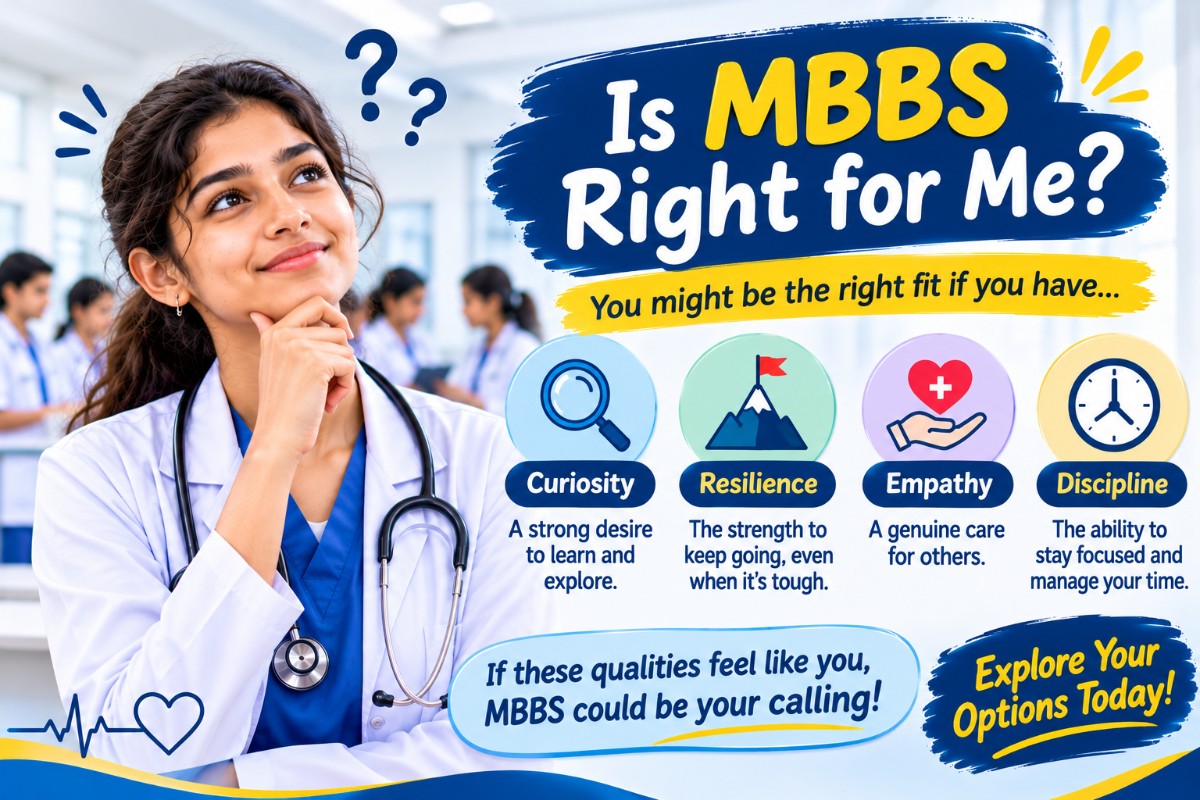
MBBS may suit you if you:
- Are genuinely interested in medicine, patient care and the human body.
- Enjoy Biology, Chemistry and Physics and are ready for a heavy study load.
- Can stay calm and focused in stressful situations.
- Are prepared for a long training path that includes postgraduate study for many specialties.
- Have the commitment to keep learning throughout your career.
Medicine also involves emotional strain, long hours and big responsibility. Speaking to doctors or medical students can help you understand the daily reality before you commit.
Why Study MBBS in Bangalore?
Bangalore has a wide healthcare network, including government teaching hospitals, private multi-speciality hospitals and specialised centres. For medical students, this can offer useful clinical exposure, depending on the college and its hospital arrangements.
- Clinical exposure: Teaching hospitals give students patient contact across departments under supervision.
- Healthcare network: A large number of hospitals and specialists can help students understand different medical fields.
- Academic environment: Medical colleges in the city draw students from across India, which builds a diverse peer group.
- Training for postgraduate exams: Coaching and study resources for NEET-PG and other exams are widely available.
Studying in Bangalore does not guarantee a seat, a postgraduate rank or a job. Outcomes depend on your effort, the quality of training and the rules in force. Judge each college on verified information, not advertising.
MBBS Eligibility Criteria
Eligibility is set by the National Medical Commission and the admitting authorities, and it can change. In general, applicants need:
- Class 12, PUC or an equivalent examination with Physics, Chemistry, Biology or Biotechnology, and English.
- The minimum aggregate marks in Physics, Chemistry and Biology required for their category.
- To meet the minimum age requirement on the date specified in the NEET and admission rules.
- A valid qualifying score in NEET-UG, which is mandatory for admission to MBBS in India.
Category, domicile and quota rules differ between all-India and state counselling. Always read the latest official notifications rather than relying on last year's information.
How Does MBBS Admission Work in Bangalore?
Admission to MBBS in India is based on NEET-UG. The overall process involves the exam, counselling and then the college's admission formalities. Follow official notifications for the current cycle.
Step 1: Register and appear for NEET-UG
NEET-UG is conducted by the National Testing Agency (NTA). Register on the official portal, submit documents and appear for the exam.
Step 2: Check your result and rank
After the result, note your score, rank and category rank. These determine which seats you can be considered for.
Step 3: Understand the counselling routes
All-India quota seats, deemed universities and central institutions are generally handled through counselling by the Medical Counselling Committee (MCC). State quota seats are filled through the respective state counselling, which for Karnataka is conducted by the Karnataka Examinations Authority (KEA).
Step 4: Register, fill choices and take part in rounds
Register for the relevant counselling, pay the specified fees, fill your college and course choices carefully and follow the rounds of seat allotment.
Step 5: Verify the college and seat details
Before accepting a seat, check the college's NMC recognition, the seat category, the fee structure and the admission conditions.
Step 6: Complete document verification and admission
Report to the allotted college with the required original documents, complete verification and pay fees only through official channels, keeping every receipt.
Types of MBBS Seats: Government, Private, Management and NRI
Seats can fall into different categories depending on the college and the state rules. Seat availability, eligibility conditions and fees differ for each:
- Government quota seats: Allotted on merit through counselling at government and some private colleges, usually with lower fees.
- Private college seats: Allotted through the applicable counselling or institution process, with fees set as per the applicable regulations.
- Management quota seats: Filled by the college within the framework set by the authorities, and normally still linked to NEET.
- NRI quota seats: Reserved for eligible NRI candidates under specific conditions that must be verified.
Rules on these categories change by state and year, so read the current notification and ask each college for a written fee structure. Be cautious of anyone who guarantees a seat or asks for large payments outside the official process.
MBBS Syllabus: What Will You Study?
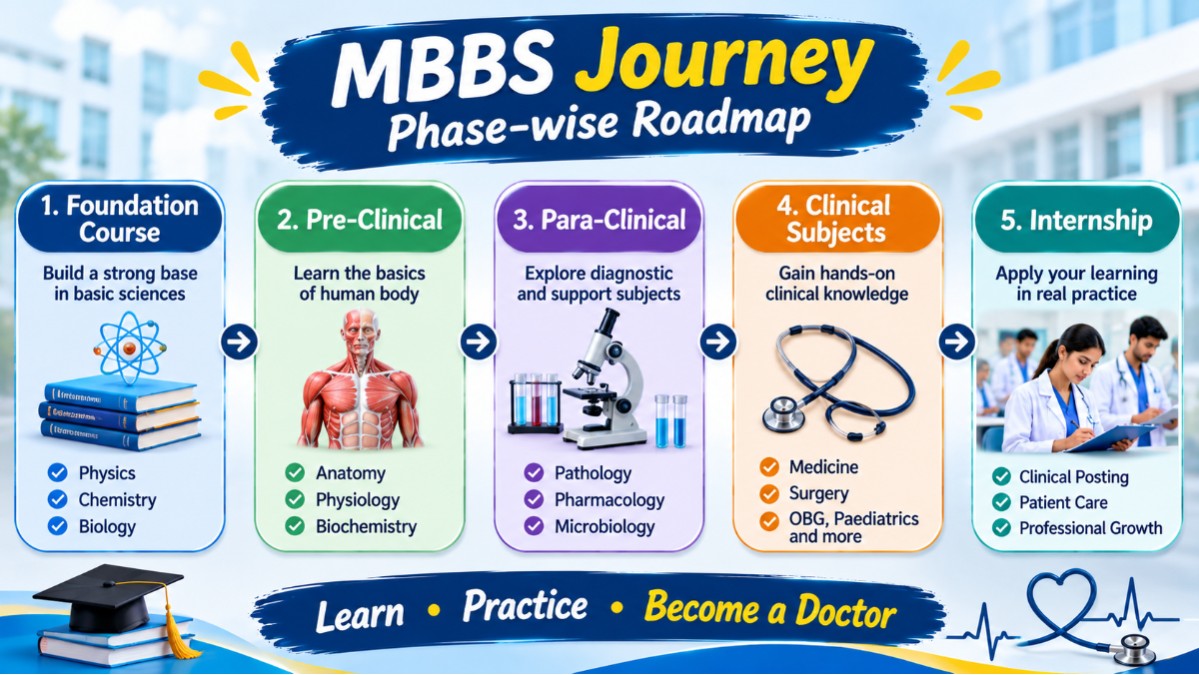
The programme follows the competency-based curriculum prescribed by the National Medical Commission. The exact schedule and weightage are set by the NMC and the affiliating university, and they can change. In broad terms, the course moves through these phases:
Foundation course and pre-clinical subjects
- Orientation and foundation course for first-year students.
- Anatomy, physiology and biochemistry.
Para-clinical subjects
- Pathology, microbiology and pharmacology.
- Forensic medicine and toxicology.
- Community medicine and public health.
Clinical subjects
- General medicine and general surgery.
- Obstetrics and gynaecology.
- Paediatrics and orthopaedics.
- ENT, ophthalmology, dermatology, psychiatry and other clinical subjects.
Compulsory rotating internship
After the academic phase, students complete a one-year internship, rotating through hospital departments and gaining hands-on experience under supervision. The internship is generally mandatory for degree completion and registration.
Skills a Good Doctor Develops
- Clinical reasoning: Linking symptoms, history and tests to reach a diagnosis.
- Communication and empathy: Listening carefully and explaining conditions clearly to patients and families.
- Decision-making under pressure: Staying calm in emergencies.
- Ethics and professionalism: Respecting consent, privacy and patient dignity.
- Teamwork: Working with nurses, technicians and other doctors.
- Continuous learning: Keeping up with new research, guidelines and techniques.
How to Choose the Right Medical College in Bangalore
1. Verify NMC recognition and affiliation
Confirm through the NMC website that the college is permitted or recognised and that it is affiliated with the relevant health sciences university. Do not rely only on the college's own claims.
2. Check the teaching hospital and patient load
Clinical learning depends on patient exposure. Ask about the attached hospital, number of beds, departments and how clinical postings are organised.
3. Review faculty and academic support
Look at faculty strength and qualifications, teaching methods, library and laboratory facilities and mentoring.
4. Look at results and outcomes with evidence
Ask for recent university exam results, internship completion and postgraduate entrance outcomes, with the reporting year. Avoid colleges that promise guaranteed ranks or placements.
5. Understand the complete cost
Request the official fee structure in writing, including tuition, hostel, examination, internship and other charges, for the specific seat category. This article does not quote fees because they differ by college, quota and year.
6. Consider campus life and student support
Check hostel facilities, safety, travel to clinical sites and student support services. Speak with current students or alumni if you can.
MBBS vs Other Courses: Course Comparison
Many students compare MBBS with other healthcare courses. Durations and admission routes follow current regulations, so confirm them with the official authority.
MBBS vs BDS: Which should you choose?
MBBS trains you in general medicine and surgery across the whole body, with options to specialise later. BDS focuses on dental and oral health. Both use NEET-UG and involve long training, so choose based on whether you want to treat a broad range of medical conditions or specialise in dentistry.
MBBS vs BAMS and BHMS
MBBS is based on modern allopathic medicine, while BAMS and BHMS are based on Ayurveda and homoeopathy. Their scope of practice, postgraduate routes and career paths differ and are governed by different regulators. Understand these differences clearly before deciding.
MBBS vs B.Sc Nursing
Doctors diagnose and prescribe treatment, while nurses provide continuous patient care and support treatment plans. Both are essential healthcare roles. Nursing has a shorter course and different admission routes. You can read our guide on B.Sc Nursing in Bangalore for a detailed comparison.
What to compare before deciding
- Course duration, difficulty and total cost.
- Admission route and NEET score requirements.
- Scope of practice and career growth.
- Recognition and registration requirements.
- Your own interest in the field.
MBBS in India vs MBBS Abroad
Some students consider studying MBBS in other countries. If you plan to practise in India afterwards, the National Medical Commission has specific requirements for foreign medical graduates, including eligibility to take up the programme abroad, a screening test and internship conditions. These rules change, so check the latest NMC notifications before choosing any overseas programme.
- Check that the foreign university is recognised by that country's medical authority and is acceptable under NMC rules.
- Compare the language of instruction, clinical exposure, fees and living costs.
- Understand the licensing or screening exam you must pass to practise in India.
- Avoid agents who promise guaranteed admission or guaranteed licensing results.
Career Opportunities After MBBS
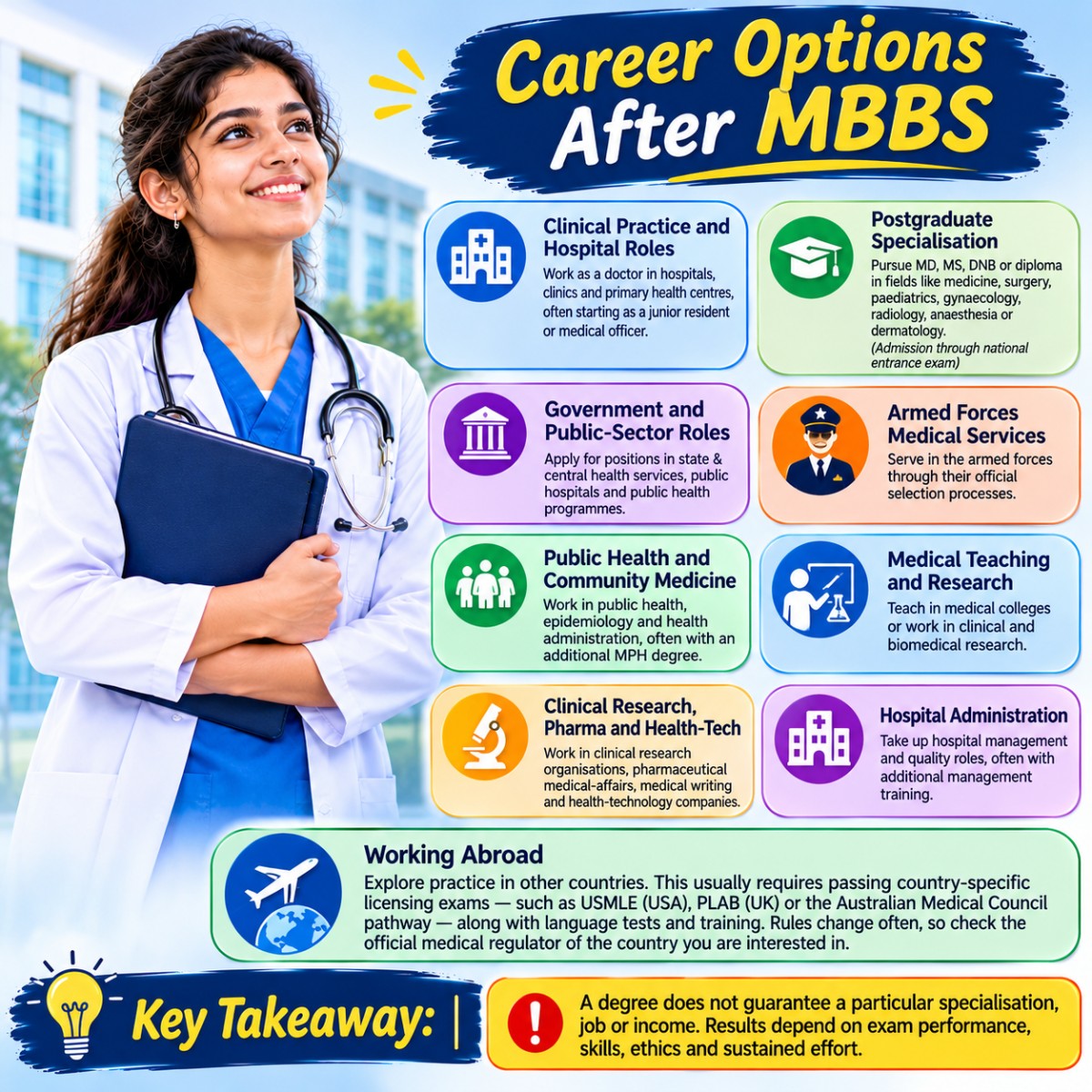
After completing MBBS and the internship and registering with the medical council, graduates can pursue many paths. The route you take depends on your interests, exam performance and opportunities.
Clinical practice and hospital roles
Graduates can work as doctors in hospitals, clinics and primary health centres, and may start in junior resident or medical officer roles depending on the employer and rules.
Postgraduate specialisation (MD, MS, DNB, diploma)
Many MBBS graduates specialise in fields such as medicine, surgery, paediatrics, gynaecology, radiology, anaesthesia or dermatology. Admission is through the national entrance examination for postgraduate medical courses. Check the current exam name and rules on official sites.
Government and public-sector roles
Doctors can apply for roles in state and central health services, public hospitals and public health programmes through the relevant recruitment processes.
Armed forces medical services
Armed forces medical services recruit doctors through their own official selection processes. Eligibility and procedures are published by the respective services.
Public health and community medicine
Some graduates move into public health, epidemiology and health administration, sometimes with an additional qualification such as a master's in public health.
Medical teaching and research
With postgraduate qualifications and experience, doctors can teach in medical colleges or work in clinical and biomedical research.
Clinical research, pharma and health-tech
MBBS graduates also work in clinical research organisations, pharmaceutical medical-affairs roles, medical writing and health-technology companies.
Hospital administration
Doctors may move into hospital management and quality roles, often with additional management training.
Working abroad
Some doctors explore practice in other countries. This generally requires passing that country's licensing examinations, such as USMLE for the USA, PLAB or the relevant pathway for the UK, or the Australian Medical Council pathway, along with language tests and training requirements. Rules change often, so check the official medical regulator of the country you are interested in.
A degree does not guarantee a particular specialisation, job or income. Results depend on exam performance, skills, ethics and sustained effort.
How Students Can Prepare for NEET-UG
- Build strong basics: Focus on NCERT concepts in Biology, Chemistry and Physics.
- Practise regularly: Solve previous-year questions and take timed mock tests.
- Revise in cycles: Make short notes and revisit weak topics often.
- Manage time and stress: Plan a realistic daily routine with breaks and sleep.
- Keep documents ready: Organise identity, category and domicile certificates early for registration and counselling.
Is MBBS the Right Career Choice for You?
MBBS can be a deeply rewarding career for students who care about helping people and are ready for years of study and responsibility. It offers many routes into clinical practice, specialisation, teaching, research and public health.
At the same time, it is a long, competitive and expensive path, and not everyone secures a seat on the first attempt. Compare MBBS with BDS, BAMS, nursing and other healthcare options, check college recognition carefully and, if you need help, speak with a counsellor who can explain the counselling process and your options.